
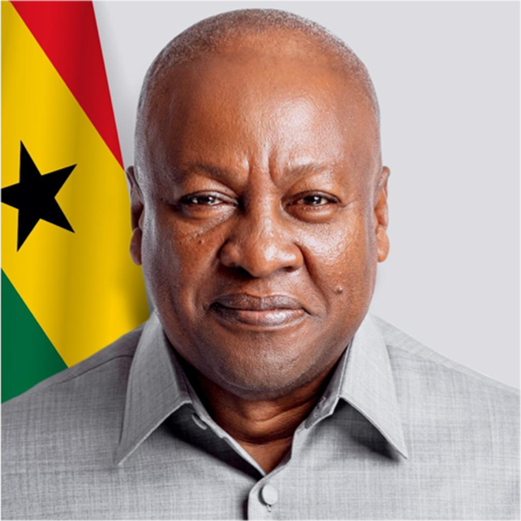
Service, Leadership, and Resilience
1958 – 1988: Early Life and Education
John Dramani Mahama was born on November 29, 1958, in Damongo, in the Savannah Region of Ghana. He is the son of Emmanuel Adama Mahama, a former Member of Parliament and Regional Commissioner under Dr. Kwame Nkrumah.
He attended Achimota School and Ghana Secondary School in Tamale before proceeding to the University of Ghana, Legon, where he earned a Bachelor of Arts degree in History in 1981 and a Postgraduate Diploma in Communication Studies in 1986.
He furthered his education in Social Psychology at the Institute of Social Sciences in Moscow, graduating in 1988.
Before entering politics, Mahama worked as a teacher, later joining Plan International Ghana and the Japanese Embassy in Accra as an Information Officer, gaining valuable experience in communication, development, and diplomacy.
1996 – 2009: Entry into Politics and Parliamentary Era
John Mahama entered politics in 1996 when he was elected as the Member of Parliament for the Bole-Bamboi Constituency on the ticket of the National Democratic Congress (NDC).
Between 1997 and 1998, he served as Deputy Minister of Communications under President Jerry John Rawlings, and in 1998, he was promoted to Minister for Communications. In that role, he oversaw the liberalization and modernization of Ghana’s telecommunications sector.
From 2001 to 2009, he remained in Parliament as part of the opposition, serving as Minority Spokesperson on Communications and later as Ranking Member on Foreign Affairs.
He represented Ghana internationally, including at the Pan-African Parliament, where he served as Chairman of the West African Caucus, becoming a respected voice for democracy, governance, and youth empowerment within the NDC.
2008 – 2012: Vice President of the Republic
In 2008, Professor John Evans Atta Mills selected Mahama as his running mate for the national elections. After the NDC’s victory, Mahama was sworn in as Vice President of Ghana on January 7, 2009.
As Vice President, he chaired several key national committees on communications, youth employment, and poverty alleviation.
He represented Ghana at numerous international forums and played an instrumental role in promoting digital transformation and infrastructure development.
2012 – 2017: President of the Republic of Ghana
Following the passing of President Atta Mills on July 24, 2012, John Mahama was sworn in as President, becoming the first Ghanaian head of state born after independence.
He won the December 2012 presidential election, defeating Nana Addo Dankwa Akufo-Addo.
His administration launched the “Better Ghana Agenda,” which prioritized infrastructure, healthcare, education, energy, and ICT.
Key achievements included expansion of the national road network, completion of the Kwame Nkrumah Interchange, construction of regional hospitals and community secondary schools, and growth of the oil and gas sector — including the TEN oil fields.
Despite these accomplishments, his tenure faced challenges such as economic pressures, energy crises (“dumsor”), and corruption allegations.
He lost the 2016 election but peacefully handed over power, further strengthening Ghana’s democratic image.
2017 – 2024: Opposition Leadership and Political Resilience
After leaving office, Mahama continued to play a pivotal role in Ghanaian politics, remaining a unifying figure within the NDC.
In 2019, he was elected as the NDC’s flagbearer for the 2020 presidential election.
Although he lost that election to President Akufo-Addo, his leadership during this period was marked by reform advocacy, youth engagement, and a call for transparency in governance.
He championed the “Building the Ghana We Want” agenda, emphasizing economic recovery, job creation, and national unity.
Mahama’s humility, experience, and people-centered approach earned him broad respect across the political spectrum.
2025 – Present: Return to Power
In December 2024, John Dramani Mahama was re-elected President of the Republic of Ghana, winning approximately 56.5% of the valid votes and defeating Dr. Mahamudu Bawumia of the NPP.
On January 7, 2025, he was sworn in for a non-consecutive second term, making history as the first leader in Ghana’s Fourth Republic to return to power after a previous defeat.
His running mate, Professor Jane Naana Opoku-Agyemang, became Ghana’s first female Vice President.
Under his renewed administration, Mahama launched the “Reset Ghana Agenda” — focusing on economic reconstruction, restoring integrity in governance, and creating sustainable jobs through industrialization and digital transformation.
A major policy highlight is the 24-Hour Economy Initiative, aimed at maximizing national productivity and employment.
Political Legacy and Leadership Identity
H.E. John Dramani Mahama stands as a symbol of resilience, democratic maturity, and visionary leadership.
He is widely admired for his calm temperament, communication prowess, and strong grassroots connection.
From his beginnings as a young parliamentarian to serving as a two-term president, his journey mirrors Ghana’s democratic evolution — one built on inclusiveness, progress, and reform.
Mahama’s enduring political legacy continues to inspire hope for a prosperous, just, and united Ghana